
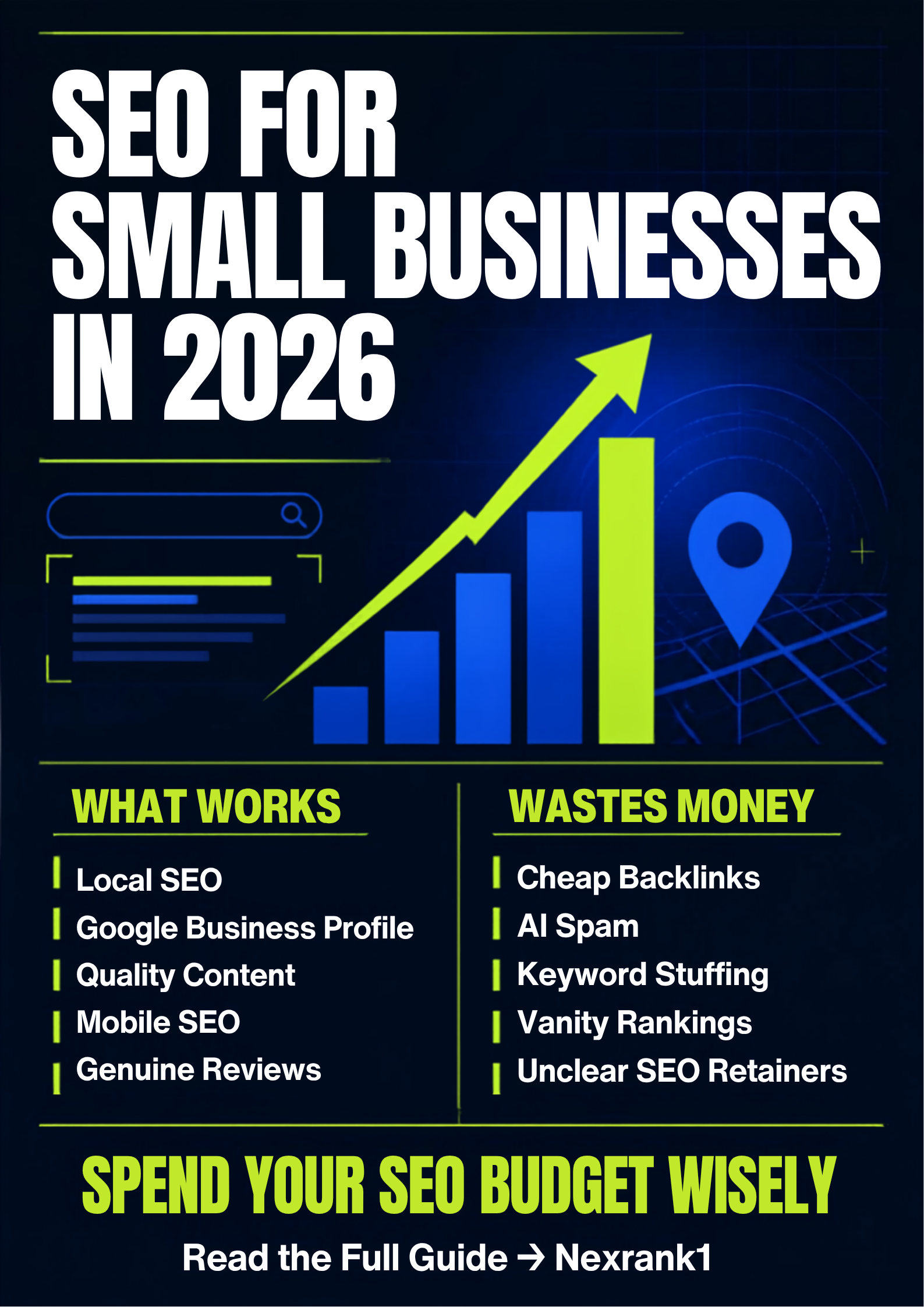
SEO for Small Businesses in 2026: What Actually Works and What Is a Waste of Money
Let’s be honest. If you have a small business, you’ve undoubtedly been burnt by SEO at least once. Or a company promised you “page one rankings” and handed you a fat invoice instead. Maybe you purchased content that sounded like it was written by a robot during a power outage.
Here’s the good news: SEO in 2026 still works great for small businesses. You just have to know where to spend your money and where to put on the brakes.
This guide explains it in plain English. No jargon dumps. No fluff. By the end, you’ll know exactly what’s worth your budget and what’s quietly draining it.
At Nexrank1, we focus on practical SEO strategies designed around search visibility, useful content, and business growth—not empty metrics.
What Really Works in 2026
Search has evolved. The old tricks are less effective thanks to AI-generated answers, zero-click results, and increasingly sophisticated search systems.
But the basics? They’re stronger than they’ve ever been.
Here’s how your money can make a real difference.
- Search Intent Alignment
This is the big one.
Google is no longer just matching keywords. It tries to understand search intent.
Someone searching “best plumber near me” wants to hire someone today. If someone searches “how to fix a leaky faucet,” they expect a guide.
If you throw a sales page at the second person, you lose.
Do this next: Check your top pages. Ask one question for each:
“What does this person actually want?”
Make sure the page gives them that answer quickly.
Key takeaway: Make the page fit the purpose behind the search query.
- Local SEO That’s Actually On Point
For many small businesses, local SEO can be one of the most valuable areas to focus on.
Your Google Business Profile is important here. Keep it complete, accurate, and up to date.
- Complete all fields: hours, services, categories, and photos.
- Post relevant updates when appropriate.
- Respond to customer reviews professionally.
- Keep your name, address, and phone number consistent across the web.
That last point is more important than people realize. Mismatched business information across directories can make it harder for search engines to confidently connect your business information.
The bottom line: A strong local presence can be more valuable to a neighborhood business than spending heavily on unnecessary website features.
- Unique, High-Quality Content
Content is still important, but the standard has been raised.
Google increasingly emphasizes content that demonstrates real experience and genuinely helps people answer their questions.
Write about what you actually know.
A landscaper discussing what grass survives a drought is likely to create more useful content than a generic “5 Tips for a Green Lawn” article rewritten from ten other websites.
Original photos, real customer stories, and specific local details can make content more useful and authentic.
Do this next: Pick three questions that your customers always ask you. Write one honest, detailed page for each.
- Technical Basics — Not a Full Overhaul
A perfect technical score isn’t required for every small business.
You need the essentials working properly.
Focus on:
- Speed: Pages should load quickly, especially on phones.
- Mobile-friendly design: Local searches are heavily mobile-driven.
- Clean structure: Use clear titles, simple URLs, and working internal links.
- Security: HTTPS should be properly implemented.
Fix the fundamentals before obsessing over every technical SEO score.
Key takeaway: Get the basics right before spending your entire budget chasing minor technical improvements.
- Reviews and Trust Signals
Trust is what sells.
Reviews can influence how potential customers perceive your business, while genuine customer feedback can also contribute to your overall local presence.
Fresh, genuine reviews tell potential customers that your business is active and serving real people.
Also include trust signals such as:
- Certifications
- Guarantees where applicable
- Clear contact information
- Real team photos
- Customer testimonials
- Relevant business credentials
Do this next: Set up a simple system to ask satisfied customers for an honest review after completing a job. A quick message with a direct review link can make the process easier.
- Conversion-Focused Pages
No one calls? Then traffic alone isn’t enough.
This is where many small businesses lose money.
Your important pages need a clear next action.
Make your phone number easy to click. Add a simple contact form. Explain exactly what happens when someone reaches out.
Key takeaway: Rankings bring visitors to the door. Your website has to give them a reason to take the next step.
What Wastes Your Money
Now for the fun part.
These are some of the common areas where small businesses can waste their SEO budget. Cut them out and you can get more value from the money you’re already spending.
- Vanity Rankings
Being #1 for a keyword nobody searches for isn’t a meaningful business result.
Some agencies may report rankings that look impressive on a dashboard but don’t generate calls, enquiries, bookings, or sales.
Focus on search visibility that connects with your actual customers.
- Using Too Many Keywords
Cramming your target term into every sentence used to be common SEO practice.
Today, it mostly makes your writing uncomfortable to read.
Write naturally. Use your main phrase where it makes sense, then focus on answering the reader’s question.
- Cheap Backlink Schemes
“Get 500 backlinks for $99!”
Run away. Fast.
Large quantities of low-quality links from spammy or irrelevant websites can create SEO risks and provide little meaningful value.
A smaller number of relevant, legitimate mentions from real websites can be much more useful than thousands of junk links.
- AI Spam Content
AI can be a helpful tool.
But churning out shallow, generic articles without adding original information, experience, or value isn’t a sustainable content strategy.
Use AI to assist with research, organization, or editing—but make sure your final content actually provides something useful and distinctive.
- Bloated Retainers with Unclear ROI
If you can’t tell what your SEO money is buying each month, that’s a problem.
Be cautious of vague reports filled with impressions and ranking positions but no meaningful connection to enquiries, leads, conversions, or business goals.
You deserve to understand what you’re paying for.
Next, do this: Ask your SEO provider:
“What measurable business results did our SEO work contribute to last month?”
A good SEO partner should be able to explain the work being done and the metrics being tracked.
Where to Prioritize Your Budget
Not sure where to begin?
Here’s a simple priority list for most small businesses:
- Google Business Profile and local SEO
- Reviews and trust signals
- Conversion-focused pages
- Genuinely helpful content
- Technical basics
- Everything else, only after the above is working
Begin at the top.
Each step can support the next one.
Bottom Line
SEO in 2026 isn’t about complicated tricks. It rewards businesses that provide useful information, maintain a trustworthy online presence, and make it easy for customers to take action.
Match your pages to what people actually want. Take charge of your local presence. Earn genuine reviews. Write material that reflects real experience. And make it simple for visitors to become customers.
Skip the vanity metrics, spam links, keyword stuffing, and retainers that can’t explain their value.
Do the real work, measure what matters, and focus on the search visibility that can contribute to real business growth.
Want to understand what’s helping or hurting your visibility right now? Nexrank1’s SEO services can help you identify practical opportunities and build a strategy around your business goals.
Features:
- •Local SEO for small businesses
- • Google Business Profile optimization
- • SEO strategies that improve Google visibility
- • Quality content and mobile SEO
- • Genuine reviews and trust signals
- • Practical ways to avoid wasting your SEO budget
- • SEO tips for Punjab businesses



Leave feedback about this